
Sisterhood and solidarity at our Tailoring and Knitting Project
This blog post shares the findings of research carried out by Nina Wieliczko, a University of Sheffield student who completed a research placement with Kids Club Kampala (KCK) in June 2025.
This study aimed to explore the meaning of empowerment to women participating in our Tailoring and Knitting Project. Focused on women’s lived experiences, Nina conducted 15 interviews and a focus group with participants who were either involved in the project at the time or had recently graduated.
What does it mean to feel empowered?
Within the sector of international development, the term ‘empowerment’ is often reduced to a buzzword. It's treated as a box to tick - something women achieve once their income or productivity increases. But the women at KCK's Tailoring and Knitting Project tell a different story, one that compels us to think differently about what empowerment really means.
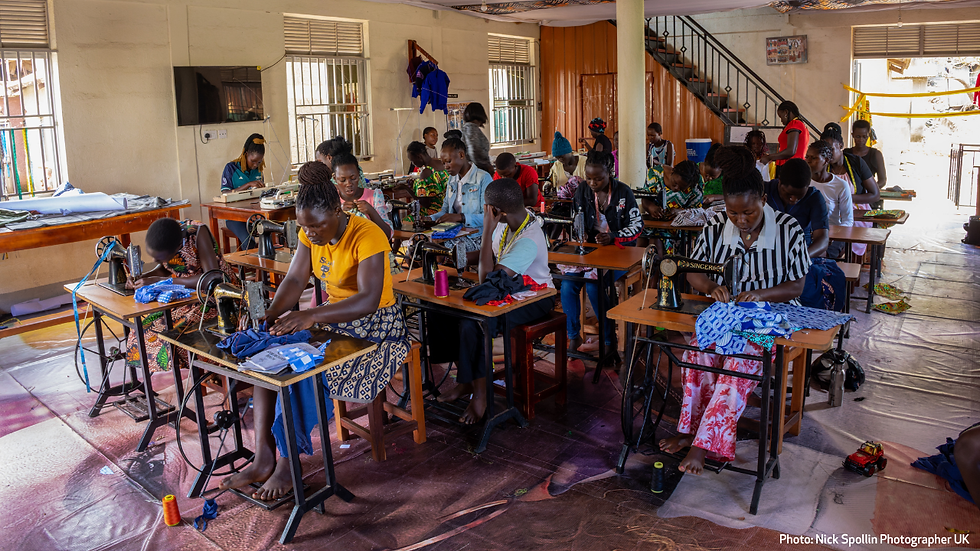
Research findings
Skill acquisition and increased income opportunities
If we think about ‘empowerment’ in the more traditional sense, KCK’s Tailoring and Knitting Project successfully empowers participants. The project enables women to learn tangible skills that can improve their economic opportunities. Many of the women described how, before joining the project, they had no route for making money, but now they have business skills and the ability to create products for income. One participant shared:
“I was like, ‘no, I have to look for something that I can do with my hands, and I can do it myself.’ So that’s why I joined here. I have so far started earning income out of the skill.”
The project also offers women the opportunity to look beyond just acquiring skills. All graduates from the Tailoring and Knitting Project are provided with sewing machines, equipment and start-up kits, enabling them to develop their skills further and become more independent after graduating from the course. This self-sufficiency is a key part of economic empowerment.
Aspirations and transformation
The project doesn’t just help women learn new skills, it also leads to meaningful personal transformations. Many participants described a shift of mindset, changing from one of low self-worth to one of pride and confidence. The women said they wanted to start their own businesses, help other women learn skills, provide for their families, and achieve financial independence. Participants shared:
“My goals for the future are training others and helping other women.”
“This project has helped to give me confidence. In those days I used to stay home, I felt so depressed. But I no longer feel that way.”
Personal transformation plays an important role in their empowerment journeys. It gives women space to see themselves as capable of real change, beyond just income generation. The findings show that creating this kind of supportive environment is key to empowerment.
Community solidarity
The research revealed that participants feel a strong sense of community solidarity. The women described how they quickly came together and formed support networks through emotional and financial support. This was evident through the desire to help other women, exchange knowledge, share resources, and provide emotional support. Participants shared:
“We always stay like sisters.”
“Challenges may come in life, but when you join heads together, you find a solution.”
The strong solidarity among women taking part in the Tailoring and Knitting Project challenges the emphasis in mainstream development on ‘empowerment’ as an individual experience. The women revealed that the relationships built on the course were essential to feeling empowered. This finding highlights a more community-based understanding of empowerment.

Conclusions
To the women participating in KCK's Tailoring and Knitting Project, empowerment did not feel individual. It was experienced as a shared, collective process. The participants supported each other, exchanged knowledge, and developed lasting support networks.
The women’s responses challenge mainstream definitions of ‘empowerment’ that focus on individual progress and economic outcomes. For international development charities, the message is clear: fostering an environment within skills training programmes that encourages connection is just as important as supporting income generation. This ensures that lasting change is experienced. Empowerment should not be seen as a tick box to be achieved; it is forever ongoing and continuously shaped by communities. KCK’s community-led initiatives demonstrate that placing connection and community at the heart of every project leads to meaningful impact.


The versatility of professional drone services makes them valuable across many industries in New York City. Real estate, construction, architecture, hospitality, media, tourism, landscaping, corporate marketing, and event production can all benefit from thoughtfully created aerial content. Each project can require different camera movements, compositions, altitudes, and deliverables, making professional planning important. High-quality drone imagery https://xizmomedia.com/ is most effective when it supports a clear purpose, communicates useful information, and integrates naturally with other photography or video created for the same project.
This project showcases real empowerment through unity, not just skills. It’s amazing what can happen when women uplift each other. For those curious about innovative tech, check this out: seedance ai 2.0.
This project sounds like it really gets to the heart of what empowerment should look like—it's about community, not just individual gain. If you’re curious about interesting visual comparisons related to heights, check out this neat tool here: height comparison chart.
Love how this project not only teaches skills but also builds community. Empowerment is about sisterhood, not just income. If you're into innovative tools, check this for a cool resource: random pokemon.
This is a powerful reminder that empowerment is a team sport, not a solo gig. The way these women band together is inspiring—makes you rethink how we define support and success in communities. If you're interested in learning more about community-driven projects, check this out: minmaxh3.art