


Family Strengthening Programme
Our Family Strengthening Programme equips parents with vocational and business skills to reduce poverty, ensure food security, and create sustainable income. These include skills such as tailoring, knitting, carpentry and agriculture, alongside training response methods to the local impacts of climate change.
The context
Across East Africa, unemployment levels are particularly high and millions of families live below the poverty line. In Kampala alone, nearly two thirds of the population is made up of unemployed or under-employed youth, who often resort to crime and dangerous work to survive.
From years of experience working closely with communities in East Africa, we have seen that limited access to education and vocational skills are the main drivers that keep young people trapped in the cycle of poverty.
As well as supporting young men, we also equip women with practical skills. We know that this is a powerful way to create change within communities, one family at a time.


Tailoring and Knitting Project
Our Tailoring and Knitting Project offers free vocational training, business mentoring and resources for women who are currently unskilled and unemployed. The project takes place in our specifically built training facility, the Hope Centre in Naguru. Our tailoring and knitting courses run for four months and we run three intakes a year. Each year we aim to help 200 unemployed and unskilled women graduate.
When students graduate from our project they receive an official government recognised qualification in the form of a certificate accredited by Uganda’s Directorate of Industrial Training, and the required start-up equipment from Kids Club Kampala, for example sewing or knitting machines. This enables them to either start their own businesses or find employment with tailoring businesses in the city, creating access to a sustainable livelihood and lift themselves and their families out of poverty.
Carpentry Project
Our Carpentry Project provides young men and boys in the slums with the vocational and entrepreneurial skills they need to earn a regular income, support their families, and move out of poverty.
The Carpentry Project includes a full-time 12 month course delivered by a trained carpentry instructor in Katanga Slum, and was set up to support young males who had not completed school, teaching them vocational and entrepreneurial skills. The workshop is a specifically built training facility for our carpentry project and can hold up to 20 students a day.
When students graduate from the carpentry project they receive an official government recognised qualification that is accredited by Uganda's Directorate of Industrial Training and the required start-up equipment to start their own business or employment. This opens up a door of employment and offers graduates the opportunity to financially provide for their family and community and break the cycle of poverty.


Our Lives, Our Land Project
The Our Lives, Our Land Project supports disadvantaged families in Western Kenya to tackle climate change, achieve food security and build sustainable incomes.
The project builds on our understanding that farmers are experts in managing the ecology of their farms. Working together with external support – in the form of new information, appropriate technology and carefully invested inputs – farmers are able to enhance crop and livestock production, protect the environment, and improve health outcomes.
Community-led training activities include: sustainable farming, fruit tree cultivation, agroforestry, beekeeping, organic kitchen gardening, climate forecasting, climate change mitigation, and climate change adaptation.
Our impact in 2025...
245
people were equipped with vocational skills through our Tailoring and Knitting Project.
167
students received business training and business support.
16
young people were equipped with vocational skills through our Carpentry Project.
4,113+
adults were provided with training in sustainable farming and climate change mitigation.
Vanessa's story
Homa Bay, Kenya
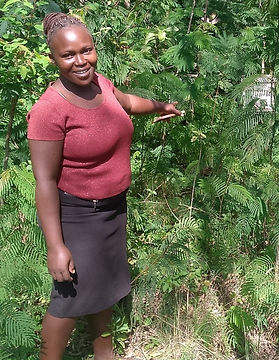
Vanessa*, a 24-year-old mother, lives in a quiet village surrounded by indigenous forest. When the Our Lives, Our Land Project began, she chose an unexpected path - beekeeping. She shared, “People told me it was not a woman’s job. But I saw bees as an opportunity, not a risk.”
With limited access to land for young women in her community, Vanessa joined a group of local beekeepers through the Our Lives, Our Land Project, gaining practical skills in apiculture and resource sharing.
Today, she is part of a group of 30 beekeepers managing shared apiary sites. Her first honey harvest brought both income and confidence, allowing her to invest in a small poultry project. Vanessa now mentors other young women, encouraging them to explore beekeeping and environmental conservation. She said, “The forest offers us a chance to become great beekeepers.”
*Name has been changed
.jpg)
What next?
Longer-term, the outcomes we expect to see are:
-
Improved long term employment or self-employment opportunities.
-
Increase in financial independence and confidence.
-
Reduced child poverty in the slum communities.

